
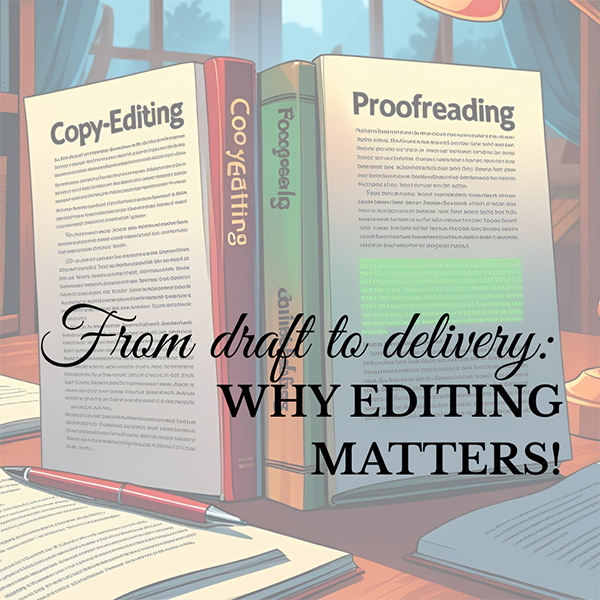
Is copy-editing and proofreading really necessary?
Written by Janice Hunt
15 July 2025
Reading time: 1,8 minutes
That depends. Clearly a lot of daily writing – emails, WhatsApps, short social media posts, feedback and so on – is shared with recipients with the belief that the message you are conveying will be understood and responded to as needed.
Having said that, experience has demonstrated for most of us, that these short comms often require self-editing to make sure there can be no misunderstanding of or umbrage taken at the content of your message by the recipient.
But when it comes to bigger things such as reports, articles or case studies – documents that need to be read, comprehended and responded to – it’s often worth going the editing and proofreading route simply to ensure that the effort you’ve put into creating a document is not wasted and your message is clear and accessible.
Copy-editing or proofreading?
The difference between copy-editing and proofreading shouldn’t be blurred.
Copy-editing involves …
So the copy-editor’s task is to ‘polish’ the text to make it flow smoothly and share the message that the writer intends.
Proofreading comes last
Proofreading is the final stage of the writing process. It focuses on a careful review of the text to identify and correct errors in spelling, grammar, punctuation and formatting.
Several proofreading stages are often called for in published material, but in general, in business or academic texts, copy-editing will usually be enough. (Of course, highly technical content is likely to need extra sets of eyes on it to make sure it is accurate and conveys exactly what it needs to.)
The best writers have editors
Avoid falling into the trap of believing that only ‘not very good’ writers need a copy-editor. Every good writer knows that their work is improved by a good editor – and every good editor knows that the ‘writer’s voice’ must be maintained and even enhanced in the editing process. Author Patricia Fuller knew that. She said, “Writing without revising is the literary equivalent of waltzing gaily out of the house in your underwear.”
As interesting as that image may be in your mind, the idea is straightforward. Don’t do it.
The end result
The edited copy would then go back to the writer for their review of and responses to the suggested edits. This means that a final proofread of the document to clean up any gremlins that may have crept in or been missed will ensure that the document will be professional, accurate and easy to read – and it will deliver on its intended purpose.